Spell Memorization & Time
A theory on AD&D

I have come to an interesting theory about AD&D and recovering spells while reading the DMG. Traditionally, I have always played that you wake up in the morning, memorize your spells, and go adventure. When you’re out of spells, that means its time to head back to town, sleep at the inn, and do it all again the next day. On the 13th, I played as a Magic-User in a game and ran into the problem of not knowing where the inn is. I used all my spells but the rest of the party was still good to adventure. So I found a safe spot, rested, then memorized a spell while other players did some adventuring. This got me thinking about how I would adjudicate it at my table and I remembered seeing a passage about it in the DMG.

In other editions like OD&D or OSE, you can't regain your spells until the start of a new day. Looking at OSE, the rule is you sleep and in the morning you wake up and spend an hour memorizing your spells. You can’t memorize your spells again until the next day. It’s like how I mentioned above and it’s pretty simple. AD&D doesn't do that, there are set periods of time the character must rest. In AD&D regaining spells is distinctly a two part process, rest must be done then prayer or study. The relevant section of the DMG is below.
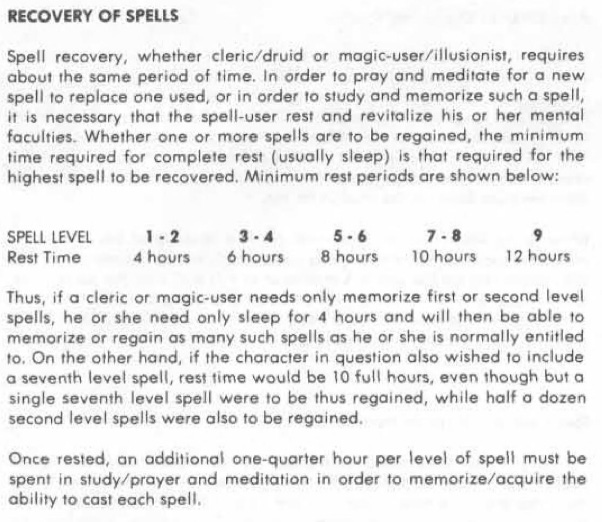
My theory is that you don’t need to memorize spells all at once. If, I was say level 3, I can memorize 2 level one spells and 1 level two spell. I wake up in the morning before we set off on the adventure and spend 30 minutes memorizing invisibility and 15 minutes memorizing magic missile. I could memorize another level 1 spell but I don't. Instead, I take my spell book with me to the dungeon. Let's say we discover a magic scroll, well I could spend 15 minutes with my book, memorize read magic, then immediately cast it. Or alternatively, if I have used my magic missile I could spend 15 minutes to prepare another one.
There are obvious downside to this. First, sitting in the dungeon looking over my musty spell book burns time, torches can go out and wandering monster checks are made. Second, I need to carry my spell book around with me which has weight. The listed weight of a Large Metal-Bound Book is 200 coins as per my copy of the DMG. The section on Magic-Users in the PHB states, "This spell book, and each book later added (as the magic-user advances in levels of ability, a book of spells for each higher level of spells which become usable will have to be prepared through study and research)..." If you enforce this rule of one book per spell level, suddenly your magic-user is carrying a lot of weight (which is good business for spell book caddies).

Unearthed Arcana has much more fleshed out rules for spell books. This includes how many spells a book can hold, upping the encumbrance of a spell book to 450 (yikes!), travel spell books, the costs of producing spell books, and experience point values for capturing them.
I am still reading through the rules to see if there is anything that prevents this but it seems kosher and makes sense within the fiction. The only thing that contradicts this (that I can find so far) is on PHB page 40 which states “Spells of any sort must therefore be selected prior to setting out on an adventure, for memorization requires considerable time. (Your Dungeon Master will inform you fully as to what state of refreshment the wind of a spell caster must be in, as well as the time required to memorize a given spell.)” I would put the passages statement on selecting spells before an adventure into the category of advice rather than a rule. If anyone knows of a section which contradicts my rule theory, please let me know.
I think the logic behind your reasoning is legitimate. Despite that, it seems to me it is more plausible that Gygax intended that spells shoud be studied immediately after waking up.(the morning has gold in its mouth).
After all, if it were not so, that would mean that a wizard with 15 minutes left (think this in terms of an unused "slot") could utilize those fifteen minutes even very late in the day. But as the day progresses, a person is usually more tired than when he just woke up (therefore you are not fully rested later in the day). But like yours, mine is just a speculation